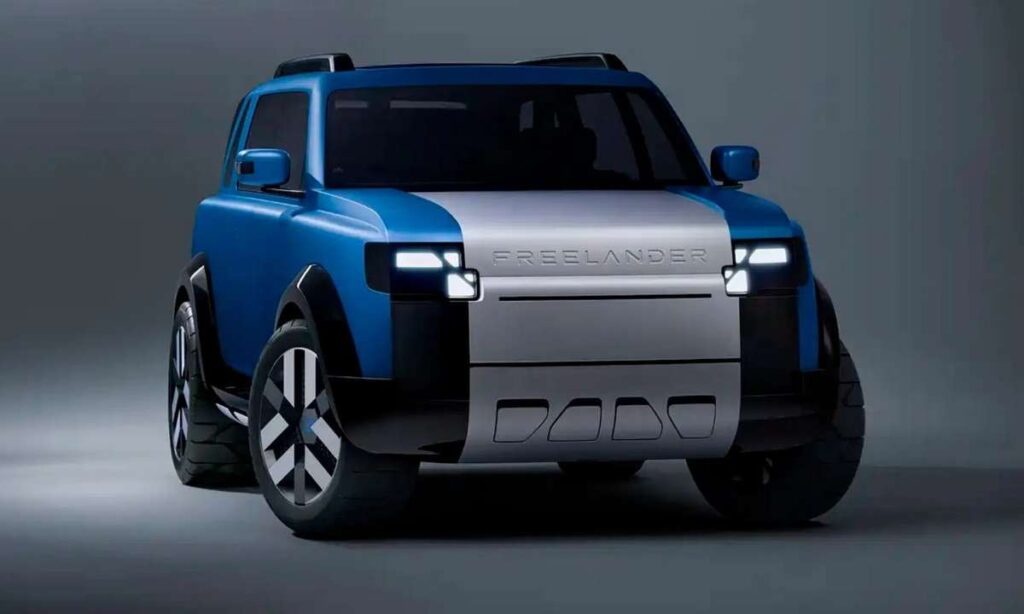
The Freelander, originally a British SUV, is back as a standalone new-energy vehicle sub-brand of Chinese automaker Chery.
[Image: Freelander Concept 97 front]
The Land Rover Freelander was discontinued in 2015 after two generations. However, the “Freelander” name is being revived as a standalone brand, specifically for new-energy off-road vehicles—and through a joint venture between Jaguar Land Rover (JLR) and Chery; ultimately becoming a sub-brand of the Chinese automaker.
Known as the Concept 97, the new Freelander was previewed in Beijing at a dedicated launch event. The number in the concept model’s name stems from the year the first-generation Freelander debuted, in 1997. The boxy concept SUV’s design takes inspiration from the first-generation Freelander and blends Land Rover’s modern design language. Eagle-eyed readers will recognise the distinctive C-pillar from the original Freelander, which references the first iteration’s detachable hardtop roof.
As a battery-electric off-roader, the new Freelander features 800 V electric architecture. However, the platform was designed to be versatile and also support plug-in hybrid (PHEV) and range-extender electric vehicle (REEV) configurations. For the former and latter, the Freelander is expected to be based on Chery’s T1X architecture and feature a dual electric-motor setup, with e-motors sited on the front and rear axles, respectively. While details surrounding the powertrains have yet to be confirmed, rumours have suggested the PHEV and REEV variants’ e-motors will be coupled with a 1.5-litre turbocharged engine developed by Ateco, a subsidiary of Chery.
Said Freelander CEO, Wei Lan, “We aspire to bring the spirit of British exploration into encounter with the power of China’s new-energy technology.”
Currently, Chery and JLR are keeping quiet about further specifications on the production model. The Freelander is currently set as a China-only model … for now. However, Lan says “international variants are currently in intensive development” and might appear in other markets after the Chinese launch.