
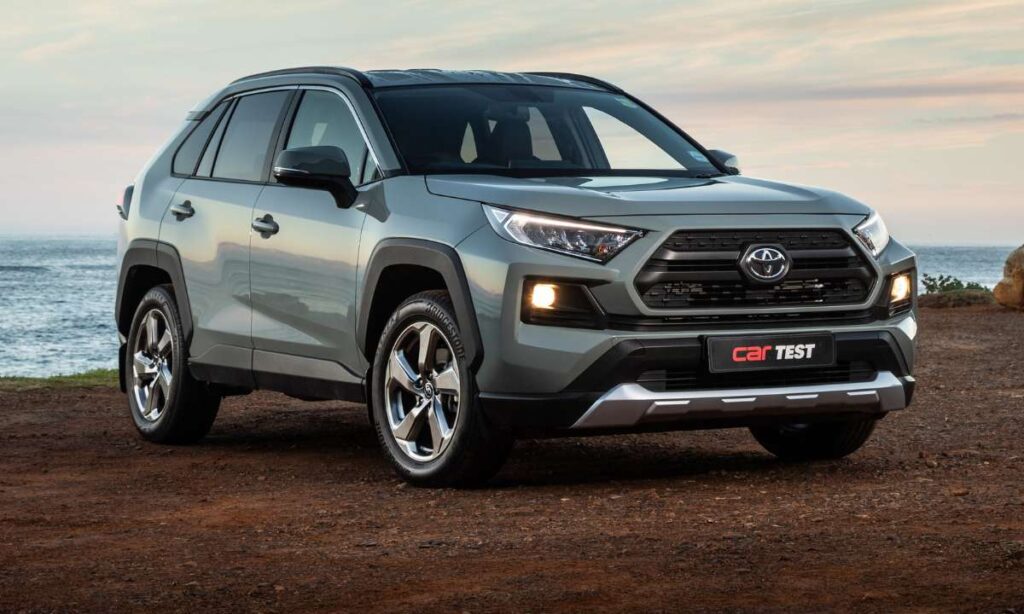
The Toyota RAV4 is about to enter an all-new generation. Here’s what you should know if you want a used fifth-generation model.
Image: CAR
The countdown to the 2026 debut of the new Toyota RAV4 in South Africa casts a retrospective spotlight on the outgoing fifth-generation model. When this generation landed in South Africa in mid-2019, it wasn’t just a modest update – it was a fundamental architectural reset for the world’s best-selling SUV. Toyota realised the RAV4 had grown soft, risking its market lead to sharper, more sophisticated Korean and German rivals. So the brand pivoted hard: stiffer mechanicals, bolder geometric styling, and a powertrain revolution that redefined the segment’s efficiency.
A quick look at the Toyota RAV4
At the heart of the fifth generation’s makeover is Toyota’s New Global Architecture (TNGA-K) platform. Moving to this modular backbone gave the RAV4 a 57% boost in torsional rigidity versus the fourth generation. The front axle uses a revised MacPherson strut setup, while the rear is a trailing-wishbone multilink arrangement. This setup allows for up to 220 mm of ground clearance. Even though the overall length is slightly shorter than its predecessor, the wheelbase is stretched by 30 mm to improve rear entry and exit, and boot space sits at 408 litres with the rear seats up. When the model first launched, the infotainment system felt a bit dated, but updates over time – including the 2022 facelift – brought important smartphone-mirroring features.
Powertrains
Initial models used Toyota’s naturally aspirated ‘Dynamic Force’ four-cylinder engines. The entry 2.0-litre unit produces 127 kW at 6 600 r/min and 203 N.m of torque at 4 400 r/min, pairing with a Direct Shift CVT. This unit features a physical first gear for stronger off-the-line engagement. For more power, the 2.5-litre ‘Dynamic Force’ four-cylinder makes 152 kW and 243 N.m, and it’s paired with an eight-speed torque-converter automatic.
But the big shift came with the RAV4 Hybrid – especially the E-Four all-wheel-drive version. The hybrid system combines a 2.5-litre Atkinson-cycle four-cylinder engine with electric motor generators. In the E-Four variants, an independent electric motor sits on the rear axle. This dual-motor setup produces a combined 163 kW and, in theory, can cover up to 1 146 km on a full charge-and-fill cycle.
What to look out for when buying a used Toyota RAV4
– High-voltage cable corrosion (AWD Hybrids): the wiring harness connector that links the rear electric motor on E-Four models can suffer moisture ingress and galvanic corrosion.
– Roof rail seal degradation: early models are prone to failing roof-rail seals, where mounting washers can deteriorate quickly and let water run down the A-pillars. This can threaten internal electronic control modules.
– Transmission hesitation and software discrepancies: hesitation, lurching, or low-speed “gear hunting” on both the 2.0-litre CVT and the 2.5-litre eight-speed automatic often point to transmission control software issues.
– Hybrid fuel-tank filling issue: some early 2019–2021 hybrids had a design flaw in the fuel-tank’s internal breather system, stopping the tank from filling to its 55-litre capacity.
– Early infotainment and connectivity gremlins: infotainment units on pre-facelifted models can freeze intermittently. Apple CarPlay and Android Auto were not standard on the earlier local units.
Which one to get
The sweet spot of this platform’s capability is the 2.5 Hybrid E-Four, preferably a post-facelift model. The hybrid drivetrain makes the RAV4 incredibly efficient, and the instant torque from the electric motors helps the Atkinson-cycle engine under hard acceleration. While the entry-level 2.0-litre GX models are more affordable, they can feel a bit underpowered when fully loaded.
In our 2022 driving impression of the Toyota RAV4 2.5 GX-R CVT Hybrid E-Four, we noted:
“Claimed fuel consumption is 4.71 L/100 km. On our test route that included town, country, gravel and freeway, we saw a consumption of 5.8 L/100 km, which, for this size of luxury vehicle, is quite spectacular and not far off the usually ambitious claim. The car runs extremely silently with excellent NVH levels. The traction control and constant shifting of drive between front and rear was unnoticeable but could be seen via the onboard display. On pull-away, more power will be sent rearwards, then in normal cruise mode, front-wheel drive will be employed. The 18-inch wheels fitted to the Hybrids cope well enough off-road and have the benefit of allowing the inclusion of a full-size alloy spare. This is not the case with others in the range. These have 19-inch wheels that are too large for the wheel well.”