The new Toyota Hilux will officially launch in SA in June 2026. We detail the upcoming, ninth-generation model…
[Image: Toyota]
Introduced in 1968, the Hilux has spent more than five decades in South Africa, where it’s long been built and remains the best-selling vehicle. After eight generations, Toyota is ready to begin a new chapter with the ninth-generation model.
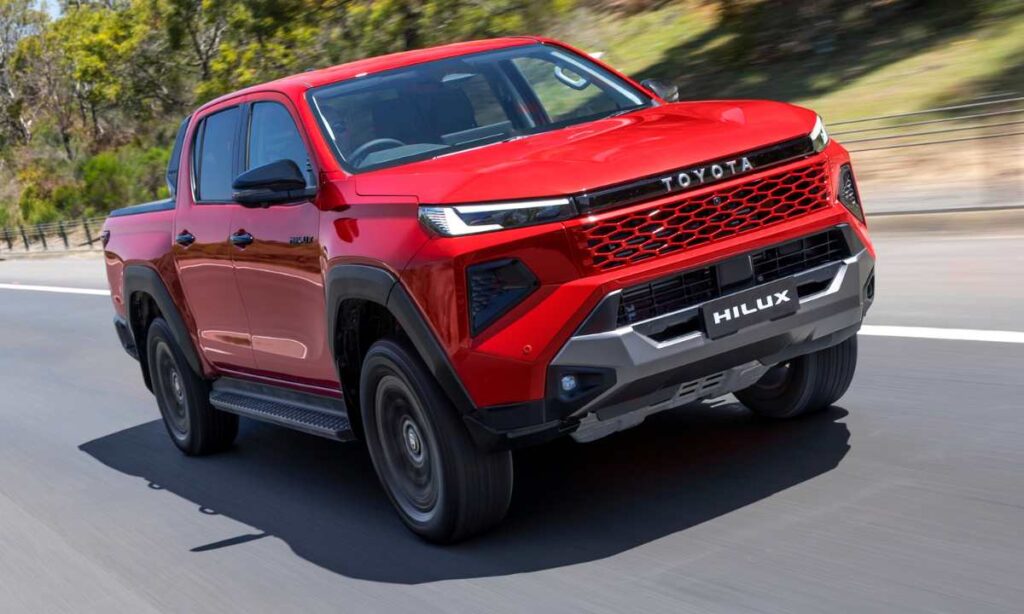
While it looks familiar from the outside, the new Hilux’s design is sharper at the front and rear. A neat update is the redesigned rear bumper, which now includes side steps to make loading easier.
The Hilux sticks with its long-running IMV (Innovative International Multi-purpose Vehicle) architecture, the platform used by every generation since the seventh in 2004. But Toyota has tweaked it with new hydraulic engine mounts and shear-type cabin mounts to improve comfort, stiffness and crash performance.
The new Hilux measures 5 320 mm in length and 1 855 mm in width, roughly the same size as the outgoing model. The wheelbase stays at 3 085 mm. On paper, the roofline is taller, and the front track is a touch narrower (1 530 mm vs 1 540 mm). Braked towing is rated up to 3 500 kg, payload up to one tonne, and water-fording depth is 700 mm.
The suspension setup carries over the mixed front independent coil springs and rear rigid-axle with leaf springs, but it’s been refined. The layout remains geared for work-focused derivatives, while the leisure-oriented models get tuned spring rates for a smoother ride. For the first time in a Hilux, the new model also uses electric power steering, aimed at better steering feel and responsiveness in all conditions.
[Image: Toyota]
Carried over from the eighth generation, the new Hilux arrives with Toyota’s 2.8GD-6 turbo-diesel in both “standard” and 48-volt mild-hybrid forms — the latter adds an 8.4 kW/65 N.m electric motor generator and a DC-DC converter. The 2.8-litre four-cylinder turbodiesel still puts out 150 kW and 500 N.m of torque from 1 600 r/min when matched with the six-speed automatic, or 420 N.m from 1 400 r/min in the six-speed manual.
Power reaches the road via either a 4×2 setup or a part-time four-wheel drive. The 4×4 variant can gain a rear differential lock and Toyota’s Multi-Terrain Select (MTS) traction control. MTS adjusts throttle and braking to control wheelspin and boost traction on different surfaces, with an Automatic setting plus presets for Mud & Sand, Rock/Dirt and Deep Snow.
Toyota has not confirmed whether the new Hilux will offer the old 2.4-litre turbodiesel, but the brand is also pushing a new multi-pathway approach to mobility, including a battery-electric drivetrain.
The company has stayed quiet on the next GR-Sport version. Still, expect the top spec to get the full GR-S treatment — a wide bodykit, wider front and rear tracks, upgraded suspension, and unique design cues. We also expect the ninth generation’s flagship to use a stronger version of the 2.8GD-6 engine.
[Image: Toyota]
Inside, the biggest upgrades are clearly on the design borrowed from the Land Cruiser Prado. The center feature is a new 12.3-inch infotainment screen with wireless Apple CarPlay and Android Auto (replacing the previous 8.0-inch unit). Higher-spec models get a digital instrument cluster of a similar size, while mid-range models stick with a 7.0-inch display. Wireless phone charging is offered with selected variants, and climate control uses physical buttons for easier operation.
The steering wheel is redesigned and now offers adjustable rake and reach, with a new layout for better ergonomics. Depending on the grade, seats can be eight-way electrically adjustable and heated.
Leon Theron, Senior Vice President of Sales and Marketing at Toyota South Africa Motors, says: “The next-generation Hilux embodies Toyota’s global vision of sustainable mobility, while staying true to our customers’ needs. In South Africa, Hilux isn’t just a vehicle – it’s a way of life. The new model blends a modern cabin with the strength, reliability, and performance our customers know and trust.”
Full feature in the February 2026 issue of CAR magazine.
Also read