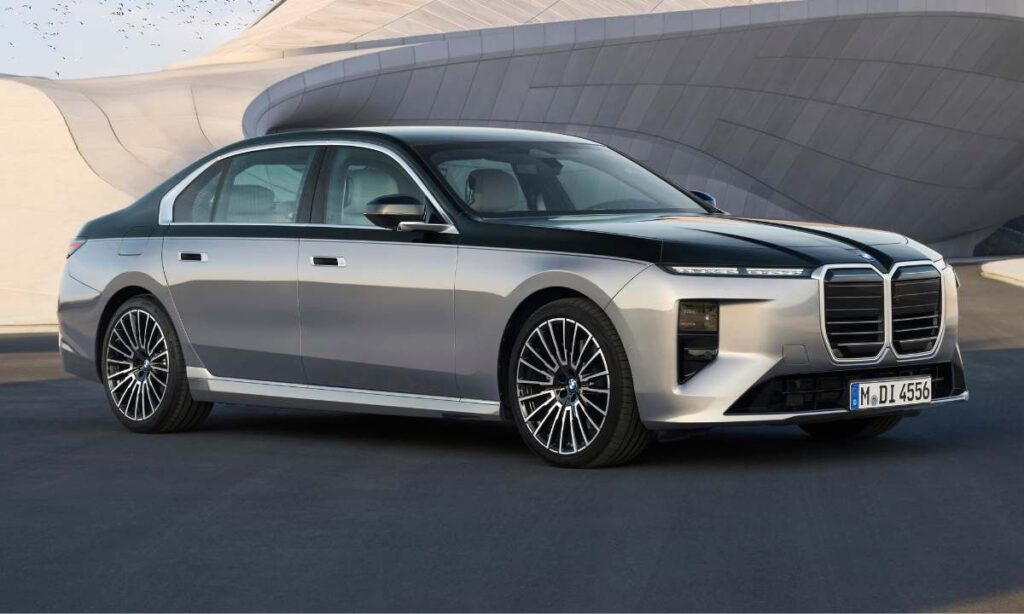
BMW has pulled the wraps off the thoroughly updated 7 Series, with BMW South Africa’s local arm confirming when the refreshed flagship will arrive in the country.
Taking a page from BMW’s Neue Klasse approach, the revised 7 Series is described by the German marque as the most extensive update it has ever carried out. The refreshed current-generation 7 Series arrives with a range of powertrains, including diesel (740d xDrive) and petrol (740 xDrive), plug-in hybrids (PHEVs; 750e, M760e xDrive), and all-electric (i7 variants: i7 50 xDrive, i7 60 xDrive, i7 M70 xDrive).
The sole diesel in the lineup, the 740d xDrive, uses a 3.0-litre inline-six turbocharged oil-burner with 48 V mild-hybrid tech, producing 210 kW and 650 N.m of torque – available from as low as 1 500 r/min. Drive goes to all four wheels via xDrive, paired with an eight-speed automatic transmission. The 740d xDrive hits 0-100 km/h in 5.7 seconds, electronically capped top speed is 250 km/h, and BMW claims a combined fuel consumption of 6.5 L/100 km.
The 740 xDrive uses a 3.0-litre turbocharged six-cylinder petrol engine delivering 294 kW and 540 N.m of torque, the latter available from 1 980 to 5 000 r/min. An eight-speed automatic sends power to all four wheels. BMW claims a 0-100 km/h time of 5.1 seconds and a top speed of 250 km/h. This petrol-only unit, with 48 V mild-hybrid tech, has a claimed average fuel consumption of 8.3 L/100 km.
Updated BMW 7 Series SA launch date
BMW has announced the updated 7 Series is expected to launch in South Africa in the fourth quarter of 2026.
The PHEV powertrain lineup kicks off with the 750e, which pairs a 230 kW/450 N.m 3.0-litre six-cylinder turbo petrol engine with a single permanent magnet synchronous electric motor — the latter producing 145 kW and 280 N.m. The 750e delivers a combined system output of 360 kW and 700 N.m, sent to the rear axle via an eight-speed automatic. The 750e has an 18.7 kWh (net) lithium-ion battery pack offering a claimed electric-only range of up to 82 km and an average combined fuel consumption of 5.0 L/100 km. The 0-100 km/h sprint is claimed to be 4.8 seconds.
The M760e xDrive’s PHEV setup uses the same ICE, here tuned to 313 kW and 540 N.m, combined with the same electric motor as the 750e. With its uprated six-cylinder, the M760e xDrive delivers a combined 450 kW and 800 N.m, enabling a claimed 0-100 km/h time of 4.2 seconds. BMW claims an electric-only range of up to 80 km and a combined fuel consumption of 5.6 L/100 km.
The i7 lineup starts with the i7 50 xDrive, which uses a pair of electric motors producing 190 kW/365 N.m and 230 kW/400 N.m at the front and rear, respectively. The 50 xDrive has combined outputs of 335 kW and 660 N.m, enabling a 0-100 km/h time of 5.5 seconds. Its 112.5 kWh (net) battery is said to provide a range of 728 km on a full charge.
The i7 60 xDrive offers combined outputs of 400 kW and 745 N.m, good for a claimed 0-100 km/h time of 4.8 seconds, with a claimed range of up to 727 km.
Leading the i7 range, the M70 xDrive features a dual electric-motor setup delivering 500 kW and 1 015 N.m of torque. BMW says this version can sprint from 0-100 km/h in 3.8 seconds and can cover up to 686 km on a full charge.
Measuring 5 395 mm in length, the updated 7 Series’ monolithic body is 4 mm longer than the outgoing model. It is slightly taller as well at 1 550 mm (vs 1 544 mm). Width and wheelbase stay the same at 1 950 mm and 3 215 mm, respectively.
Images: BMW
Image: BMW
Image: BMW
Image: BMW